
GLEN ROCK HISTORICAL & PRESERVATION SOCIETY
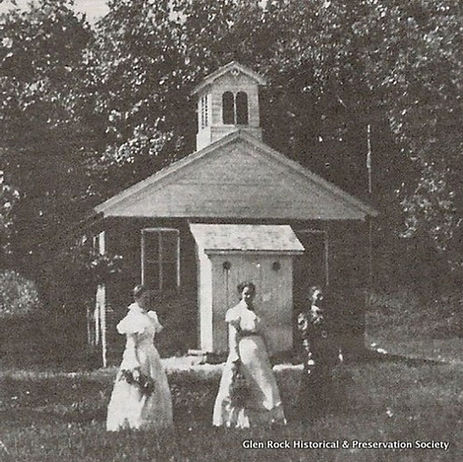
Ridgewood-Grove School #44, aka The Little Red Schoolhouse
Jane Edwards (middle) and her cousins from Paterson
The Early History of Education in Glen Rock
Education has long been a source of pride for Glen Rock residents, while at the same time presenting continual challenges for local officials and taxpayers. Long before the Borough established its own public schools, education in the area was provided through small schools connected with the Dutch Reformed churches. Every household was assessed to support these schools, regardless of whether the family had children in attendance. Educational resources were sparse. Books were scarce, classrooms were simple, and students learned with few of the comforts associated with modern education.
As public education gradually emerged during the nineteenth century, families were still responsible for paying tuition and purchasing whatever books they could afford. Students typically wrote on slate tablets using slate pencils, while attendance was often dictated by the demands of farm life. During planting and harvest seasons, many children remained at home to help their families, making regular attendance difficult.
The first known school serving what would become Glen Rock stood near the Saddle River–Franklin Township line, just south of the property owned by Garrit I. Hopper. Destroyed by a violent gale in 1824, it was quickly replaced by another school on land owned by Paul Vanderbeck. The third school, known as Ridgewood-Grove School No. 44—better remembered today as the Little Red Schoolhouse—was constructed around 1865 at the intersection of Rock Road and Ackerman Avenue. Although a historic marker placed at the site in 1964 lists the date as 1846, that date actually belongs to an earlier one-room schoolhouse that had been destroyed before School No. 44 was built. Ironically, the marker itself was purchased through donations collected by Glen Rock students, preserving an error that has remained for decades.
The land for School No. 44 was generously provided by Henry I. Hopper, who stipulated that the property would revert to private ownership whenever it was no longer needed for educational purposes. That condition was fulfilled in 1900 when Glen Rock constructed its first borough-owned school, a wooden building known as School No. 1, on Maple Avenue, approximately where the Central School parking lot stands today.
School No. 44 quickly became the educational center for most of Glen Rock's children. Although officially designed to accommodate only fifty students, daily attendance often ranged from fifty-five to seventy-five pupils. As Glen Rock continued to grow, enrollment eventually reached nearly ninety students, all taught within a single classroom. Recognizing the increasing demand, a second teacher, Miss Maude Christopher, joined the faculty in 1899. Like many women of her era, she was required to remain unmarried in order to continue teaching.
Several distinguished educators taught at School No. 44. George A. Doremus and Edward W. Murphy, who later became Superintendent of Schools in Jersey City, were among its early instructors. When Glen Rock was incorporated as a borough in 1894, John R. Lepper served as teacher. He was succeeded by John J. Ackerman in 1895 and, one year later, by Charles P. Carter, whose influence on the school and community would be especially significant.
Life inside the Little Red Schoolhouse was far different from today's classrooms. Students entered through a small lobby where a shared water pail and communal dippers were kept. Before a well was dug in the schoolyard during the 1890s, water had to be carried each day from nearby homes. A large pot-bellied stove in the center of the room provided heat during the winter, while outdoor privies served as the school's only restrooms. A raised platform at the front of the room held the teacher's desk and a slate blackboard. Students sat in shared wooden desks, often crowded three children into seats designed for two or four into benches meant for three.
The daily routine reflected the values of the era. Before Glen Rock became a borough, older boys were responsible for sweeping the floors and keeping the stove burning, while the girls dusted the classroom. After incorporation, these duties were generally assigned to a janitor, although teachers often continued to perform many of the chores themselves. During the 1890s, paper and pencil gradually replaced the traditional slate and slate pencil, signaling the beginning of more modern classroom instruction.
School was not all work. Under the leadership of Principal Charles P. Carter, organized athletics became part of student life. Carter introduced baseball to Glen Rock, organizing what is believed to have been the community's first school team to compete against Eastwood School in neighboring Westwood. Games were played on the Montress property near the present-day Central Avenue extension. During recess, students filled their time with games such as tag, duck-on-the-rock, marbles, spinning tops, and hare-and-hounds through the nearby woods. The larger boys were also known for lassoing younger students with ropes—a pastime that would undoubtedly be discouraged today.
Perhaps Mr. Carter's greatest educational contribution was the introduction of a graded curriculum. Prior to his arrival, students of every age learned together in a single room with little formal progression. Under his guidance, Glen Rock adopted a structured course of study, culminating in the borough's first eighth-grade graduating class in 1899. Peter Hoekstra, Effah Montress, and Mary A. Eagan became the first students to complete the county-prescribed curriculum, marking an important milestone in the development of Glen Rock's public school system.