
CAPTAIN DAVID MARINUS OF GLEN ROCK: A BIOGRAPHY

Article by Kathleen Walter, Borough Historian
Long before the Borough of Glen Rock was founded, the land was home to the Munsee-speaking Lenni Lenape, Wolf Clan, whose trails, clearings, and seasonal camps shaped the landscape. Pamachapuka, "Stone from Heaven" or the “Great Rock,” was a marker along one of these ancient footpaths used for trade, diplomacy, and migration from the Ramapo Mountains to the Hackensack River. This route later became Rock Road, the backbone of our town.
European contact began in 1609 in the New York and New Jersey regions, when Henry Hudson sailed the Half Moon up the river that now bears his name. Within fifteen years, Dutch traders and settlers established New Amsterdam. A 1639 Dutch map shows the region as part of New Netherland, with settlements beginning to stretch toward the interior.
In 1662, the Dutch granted land west of the Hackensack River to Andrew Zabriskie, marking the beginning of organized European settlement in that area. Only two years later, New Netherland passed to English control, becoming New York and New Jersey. King Charles II granted this vast territory to the Duke of York, who then bequeathed the land between the Hudson and Delaware Rivers to Sir George Carteret and Lord John Berkeley, setting off decades of settlement, speculation, and territorial organization.
By 1676, New Jersey was split into East Jersey and West Jersey. West Jersey attracted Quakers; East Jersey, which included present-day Bergen County, remained dominated by Dutch farming families, many of whom, like most Dutch communities of the era, were slaveholders. In 1709, the Great Rock was used as a surveying point in the controversial Ramapo Tract. The men who sold land in the Ramapo Tract lacked legal title to the land, leading to decades of judicial wrangling over deeds. The surveyor drove a copper pin into the top of the Rock to help create the 1709 map; that pin is still there today. Later, a Marinus descendant participated in renaming Pamachapuka, or the “Great Rock,” to the “Glen Rock.”
The Marinus family was shaped by this community of Dutch-speaking, agrarian, deeply rooted in the Reformed Protestant faith, people living in a culturally Dutch borderland while under British rule.
This story of our Glen Rock family begins with Reverend David Marinus (Sr)*, a gifted and unusually independent Dutch Reformed minister. In 1751, he founded the First Dutch Reformed Church of Totowa, decades before Paterson itself existed (Paterson was established in 1831). Married to Annette DuBois, David Marinus (Sr) had already been preaching locally before he became the first Dutch Reformed minister in the New World to be certified without returning to the Netherlands, a remarkable break from custom. According to Bergen County Historical Society records, the Marinus family acquired land on Doremus Avenue in Glen Rock in 1753, and their house once stood near the present-day Glen Rock Municipal Pool. Our neighborhood was called “Small Lots” then. Later in 1755, he purchased more land just above modern Reyle Avenue in Paterson near the Great Falls for £300, just as the French and Indian War erupted between England and France. Reverend Marinus served multiple congregations, including Saddle River, Pompton, and Acquackanonk, traveling constantly, preaching from church to church among the Dutch-speaking families along the Saddle and Passaic Rivers, and Diamond Brook valley.
The Great Awakening in the mid-18th century split the Dutch Reformed Church into “Old Lights” and “New Lights,” resulting in religious upheaval. Reverend Marinus aligned with the New Light reformers. In 1753, he published an article in William Livingston’s An Independent Reflector. Livingston, the future Patriot governor of New Jersey and delegate to the Continental Congress, was a leading voice for religious modernization. In 1755, Marinus published Remarks on the Disputes and Conventions in This Province, aligning himself with the progressive “Coetus” faction that sought American-trained ministers.
This intellectually progressive, Dutch-American, and politically awakening world shaped the childhood of his son. David Marinus (Jr)* was born in 1751, the same year his father established the Totowa church. According to the Bergen County Historical Society, by 1753, the Marinus family built a house in Glen Rock on Doremus Ave, where our pool currently is. David Marinus (Jr) grew up amid religious debate, political tension, and expanding Dutch settlements along the Passaic and Saddle River Valleys. He and his siblings, John, Margarite, and Garret, were raised in a household deeply connected to regional politics, religious reform, and print culture. His mother, Annette DuBois Marinus, was probably the one who taught her children to read and write because of their father’s many absences due to his itinerant ministering. We know that Annette was literate because she maintained the Totowa church vital records, documenting the parish families’ life events like baptisms, marriages, and deaths, detailing community life in her husband’s stead. Annette DuBois Marinus played the typical role of women in this time period, educating their children in civic virtues and republican and democratic values of the new American government, which became known as “Republican Motherhood.” Public discourse of the times emphasized that a woman’s primary duty was to raise well-educated, virtuous citizens who would strengthen the nation (please note: it has nothing to do with modern American political parties; this is where our parties derive their names from).
In 1772, David Marinus (Jr.) married Effy (Aegje/Sorchie) Johannes Cadmus of Slotterdam, which is the modern Fair Lawn, Elmwood Park, and Garfield region. The ceremony was held at the Hackensack Dutch Reformed Church, officiated by Reverend John Henry Goetschius, one of the most influential ministers in colonial New Jersey and an original trustee of Rutgers University. David’s father-in-law, John Cadmus, part of the wealthy and influential Cadmus family, supported the newly emerging Patriot cause, joining the Essex County militia.
David Marinus (Jr) worked as a cooper, a skilled barrel maker, branding each barrel with a distinctive mark. That branding iron was preserved by his great-great-grandson and donated in 1917 to the Bergen County Historical Society. The young colonial couple welcomed their first child, David (III), in 1773.
By the 1770s, Small Lots, what is now Glen Rock, was a patchwork of Hopper family farms, homesteads along Harristown Road, and Dutch-descended settlers clustered around crossroads and mills. The Dutch House Tavern in Fair Lawn and the old Berdan House that used to be on Lincoln Avenue were all part of the landscape. By this time, about 12,000 people of a variety of European descent lived in Bergen County, which then also included modern Passaic County.
The Revolution took shape slowly in the colonies, sparked in part by the £140 million debt Britain accumulated during the French and Indian War and Parliament’s efforts to pay it down. In 1765, the Stamp Act and Sugar Act protests led to the creation of the Sons and Daughters of Liberty organizations across the colonies, who used boycotts and intimidation to slow tax collection. New Jersey saw a single recorded tar-and-feathering in 1775. By 1767, the Townshend Acts replaced the Stamp and Sugar Acts in a further attempt to raise revenue to repay the French and Indian War debt. The pressures of these new taxes and the lack of representation in the Parliament that was levying them exacerbated the tensions between the colonial population and Parliament. The Boston Massacre occurred on the freezing night of March 5th, 1770, and by 1774, tea boycotts and protests broke out all over the 13 British North American Colonies. New Jersey’s own major tea protest occurred in Greenwich, Cumberland County, in 1774, where Sons of Liberty, disguised again as Native Americans, set fire to the cargo of the HMS Greyhound in a field near the town square. The First Continental Congress was also called in 1774, where New Jersey was represented by William Livingston.
On March 14, 1775, 35 Bergen County political leaders pledged loyalty to King George III in a letter they published in both English and Dutch newspapers of the region. Nearly all signers would become Patriots within 5 years. That letter exemplified the region’s sharp political divisions. Historians estimate 3,200 Bergen residents ultimately served as Loyalists, more than those who served as Patriots. Against this backdrop, David Marinus (Jr) cast his lot with the Revolutionary movers and shakers.
When “the shot heard round the world” rang out on April 19, 1775, at Lexington Green and the stand at the Old North Bridge in Concord, Massachusetts, happened, David Marinus (Jr) was already enlisted as part of the Bergen County Militia. In June of 1776, the Articles of Confederation Congress conscripted state militias into the Continental Army under the command of General George Washington. Marinus was now a captain in Van Cortland’s Battalion, part of Brigadier General Nathaniel Heard’s Brigade, a short-term unit of New Jersey State Troops raised for five months of service. Marinus and the roughly 35 men under his command, one of whom was his own father-in-law, were sent from Paulus Hook (Jersey City) to New York, serving General Israel Putnam to reinforce George Washington’s defenses. While he was serving, David Marinus’s second son, John, was born in 1776.
Through the summer and fall of 1776, Captain Marinus fought in the disastrous but formative campaign around New York. On August 27, 1776, the Battle of Long Island began when the Continental Army discovered British soldiers scavenging watermelons in a field. Marinus and his men were positioned there, near Flatbush, fighting in the first major battle of the campaign. They retreated to Brooklyn, then escaped with Washington’s army across the East River under cover of a miraculous fog. Running up the island of Manhattan away from British General Howe’s army, September 1776 saw the Battle of Harlem Heights, where Washington’s men finally stood their ground, boosting morale after weeks of retreat. In October of 1776, at the Battle of White Plains near Purdy Hill, Marinus’s company fought on a key flank. Despite stout resistance, the army was again forced to withdraw. By November of 1776, the Continental Army was in full retreat to New Jersey. Washington’s army and Putnam’s troops crossed the Hudson, moving through Bergen County, into Hackensack and Paramus, and the very neighborhoods the Marinus family knew intimately. Washington’s troops used the Aquackanonk bridge to cross the Passaic and burned it behind them. The pursuing British troops were forced to find the ford at the Cadmus farm in Slotterdam, Captain Marinus’s in-laws’ house! Please take a look at the new Ken Burns’ documentary “The American Revolution,” episode 3. It does not mention our friend Captain David Marinus, but the episode does a great job of showing how desperate and vicious this fighting was.
During this chaotic period, Marinus was captured in a surprise Red Coat raid. Two independent accounts survive. The New-York Gazette and Weekly Mercury (May 19, 1777) described a dawn raid on Saddle River and Slotterdam, in which Lieutenant Colonel Dongan’s Loyalist detachment seized Captain David Marinus, his lieutenant, three others, and arms, powder, ball, and a drum. According to the Cadmus family, however, the Red Coats also seized 12 horses, 6 wagons, and all the food stores in their smoke houses and storage sheds. The New York Gazette was a staunchly Loyalist newspaper that probably did not report the plundering. A letter from Patriot Major General Adam Stephen to General George Washington (May 15, 1777) confirmed that “the Tory Regiment” had carried off Captain Marinus and several others.
The apprehension was part of the escalating violence in Bergen County. Sorties, counter-raids, and brutal skirmishes devastated local farms throughout Bergen County in Hohokus, Paramus, River Vale, Hackensack, and near modern Glen Rock.
There is also a remembrance of the capture from the Cadmus family at the Passaic County Historical Society. It is part of the Cadmus family lore about the incident, passed from family member to family member. The veracity of the tale cannot be proven, and its notes about the enslaved population on the farm are quite shocking:
The edited story written by Cornelius J. Cadmus concerning the pillage of his great-grandfather’s farm and the fateful capture of John Cadmus states that: it happened about midway through the Revolution when a British raiding party, consisting of an officer and twenty-five men, appeared approaching the farm of John Cadmus. They were observed by some members of the family. John Cadmus and his son-in-law, David Marinus, recently married to his daughter, Sorchie (Effy), grabbed their bayoneted muskets and hastily retreated to the low loft above the kitchen.
When the British reached the house, the officer approached the door and assured Mrs. Cadmus that she and her four children, Andrew, Cornelius, Tryntji, and Sorchie, would be safe from harm if they behaved “civilly,” but that it was their intention to loot the place without any resistance. Due to the size of the party, no resistance seemed wise.
John Cadmus was the possessor of considerable property. He owned twenty-four slaves, twenty horses, many cows and pigs, fowl, and a large quantity of grain and hay. His smokehouse was well supplied with meats, and the potato cellars were filled with potatoes and turnips. The foragers seized twelve horses, harnessed them, took six large wagons, and proceeded to fill them with hay, oats, corn, potatoes, emptied the smoke house, taking every strip of bacon and ham; captured many of the fowl but missed the ducks and geese which were swimming on the river. When every wagon was filled to capacity, and they were prepared to drive off to New York with their loot, they held a consultation in front of the door of the farmhouse. (apparently, they felt that something irregular was taking place since none of the men of the farm had put in an appearance.)The soldiers entered the house and inquired of Mrs. Cadmus as to the whereabouts of the men. Mrs. Cadmus told them that her husband and son-in-law had gone off to the woods. Not being altogether satisfied with this explanation, the officers directed a search of the house from the cellar to the garret as well as another thorough search of the outbuildings. Since John Cadmus and David Marinus were well-known, ardent Patriots, the British desired to take them to their command in New York.
A thorough search produced nothing, but as they were about to depart, one of the men spied a scuttle trap in the kitchen ceiling. It was very small, just barely large enough for a man to squeeze through. This opening was common in those Dutch farmhouses, which had additions built at the rear of their homes for kitchens. These additions with low, sloping roofs whose eaves were just above the kitchen door had but little space above the ceiling. But it was usual for the Dutch farmwives to use this space to store away a few things which were seldom used.
The British decided to open this trap and take a look through the small, dark loft. They secured a ladder, forced open the trap, and as they approached the opening, they were met with two bayoneted muskets. Both Cadmus and Marinus belonged to the local militia, and for the soldiers to proceed meant instant death to them. Not desiring trouble in this stage, the men held another short parley at the foot of the ladder.
While these events were proceeding, Mrs. Cadmus was busily engaged. Being desperately angry at the plundering and realizing now that she might lose her menfolk to the enemy, she seized the ammunition bag which her husband failed to take with him in his hurry. She knew that the only ammunition the men had was what was contained in their muskets, so she secreted the ammunition bag under her large, full apron, crowded against the troopers who were parleying under the scuttle trap, and tossed up the bag, saying in Dutch, "Take that and help yourselves."
The plunderers, now angered by this act of the plucky Mrs. Cadmus, declared that they would secure the men at all hazards, ordered the women and the children from the house, saying that they planned to set it on fire. As the torch was made ready, the men trapped in the loft, with only the small opening as a means of escape, realized that their situation was grave. Parleying with the British, who promised kind treatment if they would come down, both John Cadmus and David Marinus decided to surrender, thus saving the farmhouse and themselves from destruction.
No sooner were the men in the kitchen when they were relieved of their muskets, seized, tied, and taken to the wagons outside. Mrs. Cadmus rushed outside, and before the teams could be started, she cut the ropes binding the men. This action was seen by the Red Coats, and the men were again tied more securely, handled very roughly, and tossed into the wagon and were driving off to New York, but not before Mrs. Cadmus upbraided the soldiers for their plundering, their falsity, and perfidy.
What had been, only a few moments before, a happy, loving home was now one filled with lamentations and woe. Their natural protectors would be thrown into prison, which might be worse than death. The slaves had been left without a master. They were practically worthless now, and a few of them were actually dangerous.
Captain David Marinus was confined in the notorious Rhinelander Sugar House in New York City, one of several sugar warehouses used as makeshift prisons. It was filthy with disease-ridden conditions and intentionally cruel treatment by the British, who viewed Patriots as traitors to the Crown. Protecting the valuable sugar, the windows of these warehouses were already barred with strong iron, making escape nearly impossible. Of the approximately 32,000 Patriot prisoners of war, 17,000 died in British military prisons and prison ships, more than those who died in battle during the Revolutionary War. At One Police Plaza, a single brick window with iron bars remains as part of the building, identifying its role in the Revolutionary War.
From this hellish place, Captain Marinus wrote to New Jersey Governor William Livingston, his father’s publisher, pleading for a prisoner exchange. The letter informed Livingston that 60 inmates contemplated joining Loyalist regiments simply to escape the horrific conditions. The Glen Rock Historical & Preservation Society recently obtained a copy of the original letter from the New Jersey State Archives, with David Marinus’s signature.

In December 1777, Captain Marinus and a fellow prisoner overpowered their guard while out to purchase food. Shoving him down, David Marinus escaped the city, stole a boat along the Hudson, and made his way back to Effy and his two sons in Bergen County. But the ordeal destroyed his health. Captain David Marinus died on January 16, 1778, only two weeks after returning home.
After the loss of her first husband, and with two young boys to raise, Effy Marinus married Jacob Ackerman in 1780 and welcomed two more children into their blended family. She lived in the Wagawar area until 1838, collecting Captain David Marinus’s Revolutionary War pension. The will of her second husband, Jacob Ackerman, included provisions for her Marinus sons, David (III) and John, and wrote of his stepsons in very warm terms. This will also “bequeathed” an enslaved woman to Effy Marinus Ackerman’s daughter.
By 1790, John Marinus appeared on the Saddle River Township tax lists. In 1810, David (III) owned 60 acres in Franklin Township (today split by Glen Rock’s firehouse line). In 1815, David Marinus (III) and John purchased additional Glen Rock property from their half-sibling, Andrew Ackerman, and his wife, Elizabeth.
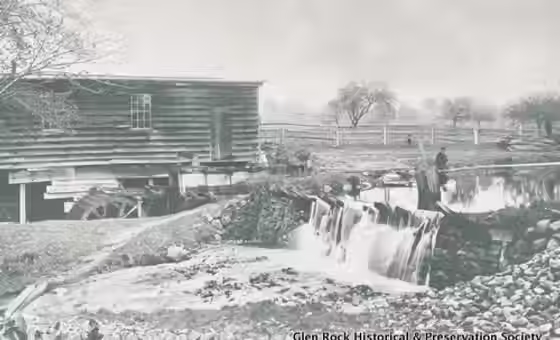
In 1870, Captain Marinus’s great-grandson, David Marinus (V), a Civil War veteran, built the Marinus Saw Mill along the Diamond Brook. He helped found the Borough of Glen Rock in 1894 and served on our first town council. The Marinus family remained in Glen Rock into the late 20th century, shaping its earliest civic and economic life. A remarkable multi-century legacy began with a young cooper-turned-captain who gave his life for American independence.
The story of David Marinus of Glen Rock is the story of a frontier community at the crossroads of cultures, empires, and revolutions. Born into a family of Dutch reformers, forged in the fire of the New York campaign, and lost to the brutal conditions of wartime imprisonment, Captain Marinus stands as one of Bergen County’s earliest and most poignant Revolutionary War heroes. His descendants helped build Glen Rock itself, transforming the ancestral lands of Lenni Lenape, the Dutch farmers, and the Revolutionary militia into the modern community we know today.
*A quick note on names: Dutch families did not use “senior” or “junior” in their names or as a social distinction–as a result, it is VERY challenging to trace the genealogy of Dutch lineage in Bergen County. To help readers keep track, we will be adding the Sr, Jr, or birth number (III) in a very British way!


Comments